
Sustainable direct bookings: when ESG data also helps drive conversions
News
May 19, 2026
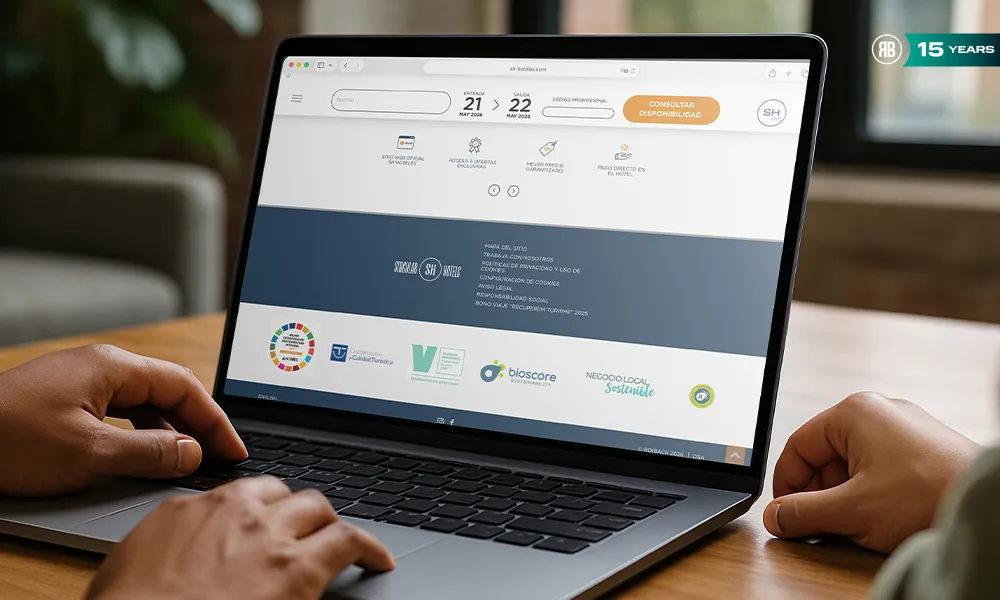

Sustainability in the hotel industry has primarily been addressed from an operational perspective: reducing consumption, optimizing resources, or meeting regulatory requirements. However, it is having an increasing impact on another key area for the sector: guest perception during the booking process.
And this is especially true for the direct channel.
Because in an environment where customers compare multiple options in just a few minutes, factors such as trust, transparency, and brand consistency are becoming increasingly important in the final decision.
Customers are looking for consistency, not just sustainable messages
In recent years, many hotels have incorporated sustainability into their daily operations. We are no longer talking solely about one-off initiatives, but rather about decisions that directly impact the management of the establishment: monitoring energy consumption, conserving water, reducing food waste, phasing out single-use plastics, and integrating environmental criteria into procurement and supplier selection.
The problem is that much of that work remains invisible to the guest.
While operations teams manage environmental metrics, certifications, and goals, customers often receive only generic messages that are hard to distinguish from those of any other hotel.
And that's where a significant disconnect arises.
Because today's traveler doesn't expect perfection, but they do expect transparency and consistency. They want to understand what the hotel is actually doing and to what extent there is consistency between its messaging and the experience it offers.
That is why the way sustainable initiatives are presented is becoming almost as important as the initiatives themselves. According to recent studies, 35% of hoteliers consider sustainability to be a key differentiator, and 75% of travelers say that a hotel’s sustainability credentials are important when they are considering making a reservation.
Sustainability is beginning to influence conversion
Just as certain factors—such as online reviews, flexible cancellation policies, and Wi-Fi—became key factors in booking decisions years ago, sustainability is now gradually being incorporated into guests’ comparison criteria.
Particularly among certain customer segments—such as international, premium, or bleisure travelers—the perception of accountability and transparency is becoming increasingly important.
In addition, booking platforms are highlighting accommodations with verified sustainability certifications, which further underscores the importance of being able to demonstrate concrete actions.
In this context, the direct channel has a clear advantage: it allows hotels to better contextualize their value proposition and create messaging that is clearer, more credible, and better aligned with the actual experience they offer.
The challenge isn't collecting ESG data. It's turning it into value.
Many hotels are already tracking sustainability-related data, though not always in a structured way. Data on energy consumption, water use, waste, emissions, and environmental compliance are part of the day-to-day operations of many establishments.
The problem is that this information tends to remain confined to technical departments, audits, or internal reporting.
And when data isn't linked to business, marketing, or the customer experience, it loses much of its potential.
Because today, measuring sustainability is no longer just about meeting certification requirements or preparing reports. It is also becoming a useful tool for improving market positioning, enhancing transparency, and building a stronger value proposition in the direct channel.
That is why more and more hotels are working to centralize ESG (Environmental, Social, and Governance) metrics and transform operational data into understandable and actionable insights.
Not to communicate more, but to communicate better.
The difference is significant.
Guests don't need to understand the technical details of an environmental indicator, but they do need to sense that there is genuine management behind the experience they are booking.
Small details that make a difference
In many cases, the impact doesn't come from large-scale sustainability campaigns, but rather from small elements that are seamlessly integrated into the customer journey.
For example:
- Show verified certifications.
- Describe specific initiatives undertaken by the hotel.
- Report measurable progress.
- Incorporate sustainability messages into the pre-stay experience.
- Integrating eco-friendly initiatives into the guest experience
These are the little details that help convey transparency and create a much stronger brand image.
And in the direct channel, where every element influences conversion, that extra bit of trust can make all the difference.
Sustainability is no longer just about reputation
Sustainability is no longer just a matter of compliance, operational efficiency, or reputational positioning; it directly influences guests’ choice of hotel and a hotel’s ability to increase revenue. More and more hotels are beginning to use ESG data as a valuable tool for distribution, marketing, and the guest experience as well.
Because today, simply measuring isn't enough. The challenge lies in transforming that information into more agile decisions, more credible communication, and more coherent value propositions.
And this highlights a growing need in the industry: to centralize data that is often scattered across different departments, suppliers, and systems.
In this context, solutions such as the Bioscore Data Platform make it possible to integrate all that information into a single environment, facilitating more structured management and helping to transform environmental, social, and governance (ESG) data into useful business insights.
Because, ultimately, the sustainability that generates the most value is the kind that is measurable, credible, and relevant to the guest.
If your hotel is working to improve its ESG management or wants to move toward a more data-driven model, we can help you organize that information and turn it into actionable insights. Contact us!
Read more

News
Roiback Receives Its Sixth Consecutive Award as the World's Best Hotel Booking Solutions Provider
By
Roiback
News
Roiback Participates in the Conference “The Balearic Islands: A Land of Opportunities for Strategic Projects” at the CEOE
By
Roiback
News
Roiback integrates DirectBooker to connect the direct channel with AI assistants
By
Roiback


