
A hotel's most profitable guest is the one you don't have to attract again
News
November 23, 2026
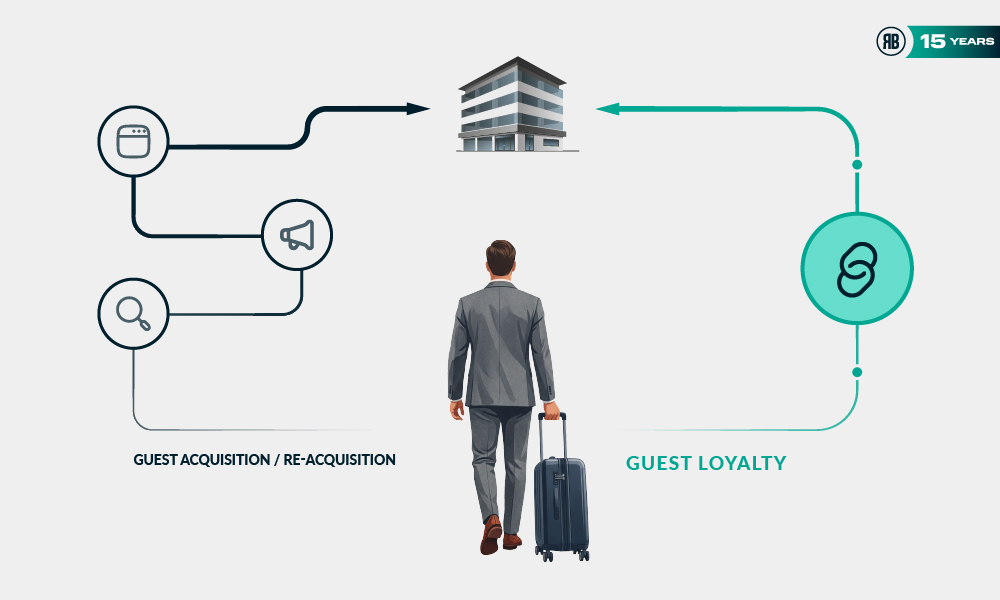
Why hotel loyalty programs have become a key strategy for reducing acquisition costs, increasing direct bookings, and maximizing the value of each guest.

Hotels are becoming increasingly aware of how much it costs to generate a reservation. They invest in Google Hotel Ads, metasearch engines, branding campaigns, social media, and other channels to attract qualified traffic and convert it into revenue. However, there’s one question that rarely appears in performance reports: How much does it cost a hotel to re-attract a guest who has booked with them before?
The answer has much more impact than it seems. Every euro spent on attracting a reservation may be a necessary investment to generate new demand. Having to reinvest that money to win back a customer who already knows your hotel, has enjoyed their stay, and has built a relationship with the brand is a very different story.
We are living in a time when acquisition costs are putting pressure on margins and competition for online visibility is intensifying. The ability to generate repeat bookings is becoming one of the key factors determining the profitability of the direct channel.
And that's where the conversation about customer loyalty takes a completely different turn.
Customer loyalty is no longer simply about offering discounts or exclusive perks. It's about reducing the cost of generating the next reservation and increasing the value of each guest over time.
The Hidden Cost of Re-Attracting the Same Guest
When a hotel analyzes its business results, it typically focuses on metrics such as occupancy, ADR, RevPAR, or booking engine conversion. However, there is another indicator that has a direct impact on profitability: the cost of reacquisition.
Let's consider a common scenario. A guest discovers the hotel through Google, a metasearch engine, or an OTA, makes a reservation, and has a positive experience. Some time later, they decide to return.
Logically, that second reservation should be more profitable for the hotel. Trust has already been established, and the guest is familiar with the brand. But often the opposite happens: the guest searches for the hotel again, compares options, and ends up booking through channels that involve new acquisition or distribution costs.
Acquiring new customers will always be necessary. The problem arises when the hotel has to compete all over again and pay to attract guests it had already managed to win over.
A guest who is already familiar with the hotel should be seen as a business opportunity, not a reason to start the acquisition process all over again.
The cost of reacquisition: a metric that few hotels analyze systematically
Let's imagine that a hotel spends 40 € to attract a direct booking. If that same guest returns the following year and the hotel has to spend another 40 € to secure a new booking, the cumulative cost of attracting that guest amounts to 80 €. If the situation repeats a third time, it reaches 120 €.
Now let's compare that scenario with another in which the hotel identifies the guest, maintains an active relationship with them, and succeeds in generating future reservations through loyalty initiatives. Although there are costs associated with technology, data management, and communications, the incremental cost of generating a new reservation is usually considerably lower.
The difference lies not only in the initial acquisition, but in the ability to turn a one-time booking into a relationship that continues to generate value over time.
Illustrative example. This assumes a cost of €40 per paid acquisition and an allocated operating cost of €8 for each repeat booking generated through loyalty programs. It does not include other overhead costs nor does it guarantee any specific savings.
In this scenario, the difference amounts to €64 per guest across three reservations. When this behavior occurs on a large scale, the impact on profitability can be significant.
That's why, in addition to measuring how much it costs to attract new customers, hotels should analyze how much it costs them to win back guests they've already acquired.
The second reserve is where true commercial efficiency begins.
The first reservation generates revenue and helps establish a relationship with the customer. The second begins to improve efficiency. That's an important difference.
For years, much of the industry has worked to optimize first-time booking conversion. And it makes sense. Without that initial acquisition, there can be no future relationship.
However, as customer acquisition costs continue to rise, profitability depends more and more on what happens after that first visit.
Every guest who books directly again reduces the average customer acquisition cost and increases the return on the investment made to secure that first reservation. In addition, it opens up new revenue opportunities through complementary services, experiences, dining, or higher room categories.
That's why the most forward-thinking hotels no longer focus solely on how many reservations they generate. They analyze how many of those reservations they can turn into repeat customers.
A one-time reservation generates revenue. An ongoing relationship can generate recurring revenue, customer insight, and operational efficiency.
Because a one-time booking generates revenue, but a relationship generates value.
From ADR to Customer Lifetime Value: The True Value of a Guest
Hotels have traditionally measured their performance using metrics such as ADR, occupancy, and revenue per stay. However, these metrics do not always reflect the true value that a guest brings to the business.
Let's imagine two guests.
If we look at just one reservation, the first guest seems to provide more value. If we look at the entire relationship, the conclusion is very different.
A second guest generates more revenue, more opportunities for upselling, and requires less marketing investment to secure a repeat booking.
This example illustrates why more and more hotels are supplementing traditional metrics with indicators such as Customer Lifetime Value (CLV), which makes it possible to estimate the economic value a guest can generate throughout their relationship with the brand, including complementary services.
Above all, it helps us understand a fundamental point: generating more revenue is not the same as generating more profitability. To determine a guest’s true value, it is also necessary to consider the costs of acquisition, distribution, incentives, and customer loyalty.
The question is no longer how much value a reservation generates, but how much value a guest can generate throughout their relationship with the hotel.
You can't build loyalty with someone who doesn't identify themselves
At this point, the conversation about loyalty is no longer just about discounts, points, or exclusive benefits.
The true purpose of a loyalty program is to enable the hotel to identify guests, get to know them, and maintain a direct relationship with them.
For years, many hotels have tried to build loyalty among customers who, in reality, remained anonymous.
A guest visits the website, browses different rooms, makes a reservation, enjoys their stay, and checks out of the hotel. Without a strategy to connect these interactions, much of that business insight is lost.
It's hard to build loyalty toward something that isn't clearly identified.
Without identification, there is no knowledge. Without knowledge, it is difficult to personalize. And without personalization, it is much more difficult to build a lasting relationship.
That is why an effective loyalty strategy is not just about offering benefits to guests.
It involves transforming available information into business actions that can generate value for both parties.
This process typically consists of five key stages:
- Identify: Recognize the guest and link their interactions with the hotel.
- Get to know them: understand their preferences, shopping habits, and behavior.
- Segment: Differentiate profiles based on their characteristics and value potential.
- Activate: Develop relevant communications and proposals at the right time.
- Convert: Encourage guests to choose the hotel again and book directly.
Customer loyalty doesn't begin when a user is given a perk.
It begins when the hotel is able to recognize each guest, understand the long-term value they can bring, and develop a strategy that turns that knowledge into future business opportunities.
Turning Data into Revenue: The Role of the Connected Ecosystem
One of the most common mistakes is to view loyalty as a standalone tool.
Its true value becomes apparent when it is part of a connected ecosystem capable of transforming data into business decisions.
When information can flow between the booking engine, the CRM, communication platforms, upselling solutions, and experience marketing tools, the hotel gains a much more comprehensive view of each guest.
This makes it possible to move from broad campaigns to much more targeted initiatives. For example:
- A guest who usually travels during the same time of year may receive an offer before their usual booking period begins.
- A customer who regularly books dining experiences may receive offers tailored to their interests.
- A traveler who has previously expressed interest in higher fare classes may receive upgrade offers when commercial opportunities arise.
- A guest who initially booked through a third party may develop a direct relationship with the hotel for future stays.
However, for all of this to be possible, there is one prerequisite: identifying the host.
And this is where customer loyalty takes on a strategic dimension that goes far beyond offering discounts or exclusive perks.
Solutions such as Loyalty 360 allow hotels to recognize and identify guests regardless of the channel through which they made their first reservation. The goal is not only to increase the number of registered members, but also to build a base of identified customers with whom to develop a direct, long-term relationship.
This nuance has a direct impact on profitability.
Each identified guest represents an opportunity to reduce reliance on marketing campaigns, metasearch engines, or intermediaries to generate future reservations.
The greater a hotel's ability to recognize its guests, communicate with them, and encourage repeat stays, the less it will need to constantly compete for their attention on channels where advertising costs or commissions apply.
Technology alone does not build loyalty. Neither does a rewards program.
But a loyalty strategy integrated into a connected ecosystem can help transform data into insights, insights into relationships, and relationships into more profitable revenue.
Because, in the end, the real opportunity isn't in handling more transactions.
The goal is to build more relationships that allow the hotel to rely less on customer reacquisition and more on the trust it has already earned.
How to Measure the Actual Impact of a Loyalty Strategy
If customer loyalty is to be understood as a profitability strategy, it must also be measured as such.
Beyond the number of registered members, there are four particularly relevant indicators:
- Repeat Guest Rate: the percentage of guests who return to stay at the hotel.
- Direct Repeat Booking Rate: the percentage of direct bookings made by repeat customers.
- Customer Lifetime Value (CLV): the estimated economic value that a guest generates throughout their relationship with the brand.
- Reacquisition cost: the investment required to win back a guest who had previously made a reservation.
When analyzed together, these indicators provide a much more accurate picture of the actual contribution of customer loyalty to the business.
What matters isn't how many members a program has. What matters is how much value they generate and how much they help reduce future acquisition costs.
From Renting to Building Your Own Demand
OTAs, metasearch engines, and other channels will continue to be essential for attracting new guests. The goal is not to replace them, but to reduce dependence on them in cases where the hotel has already established a relationship with the guest.
Every time a guest returns through channels that require new investments in customer acquisition or distribution, the hotel is renting demand. Every time a guest returns because of a direct relationship built with the brand, the hotel is generating its own demand.
That is where one of the greatest opportunities for profitability lies for the direct channel.
Hotels are the ones that provide the service, create the experience, and have the ability to maintain a relationship with guests beyond a specific stay. Customer loyalty programs allow hotels to leverage this advantage to increase repeat business, drive direct bookings, and reduce future acquisition costs.
In an environment where driving traffic is becoming increasingly expensive, building your own demand is no longer just a marketing strategy. It is a profitability strategy.
Customer Loyalty as a Strategy for Hotel Profitability
For years, customer loyalty has been associated with discounts, points, and exclusive benefits. Today, the conversation is different.
The true purpose of a loyalty strategy is to help the hotel identify guests, build direct relationships with them, and increase their value over time.
That's why the question shouldn't be how many members a loyalty program has. The question is a different one:
How many of the guests who have already chosen your hotel do you manage to get to book directly again, and how much value do they generate over the course of that relationship?
Hotels that are able to answer that question are in a better position to reduce acquisition costs, increase direct bookings, and build a more profitable and sustainable source of demand of their own.
Because a guest who has already chosen your hotel shouldn't force you to compete and pay again to attract them. It should become a competitive advantage.
And that difference is, increasingly, what sets apart hotels that simply generate reservations from those that build long-term, sustainable profitability.
If you want to analyze the potential of your current guest base and how a loyalty strategy can help you increase repeat business and reduce acquisition costs, contact our team and discover how Loyalty 360 can help you turn more relationships into profitability.
Read more

News
How Do Your Suppliers Impact Your Hotel's Sustainability? 5 Metrics to Evaluate Them
By
Roiback
News
Beyond Conversion: How Availability Can Influence the Value of Each Reservation
By
Felipe Porras, Product Development Manager at Roiback

News
The Hotel Industry's New Commercial Freedom: How to Turn It Into Greater Profitability for the Direct Channel
By
Inés Santos


