
Reducing Friction: Payment as a Strategy for Conversion and Profitability
News
October 21, 2026
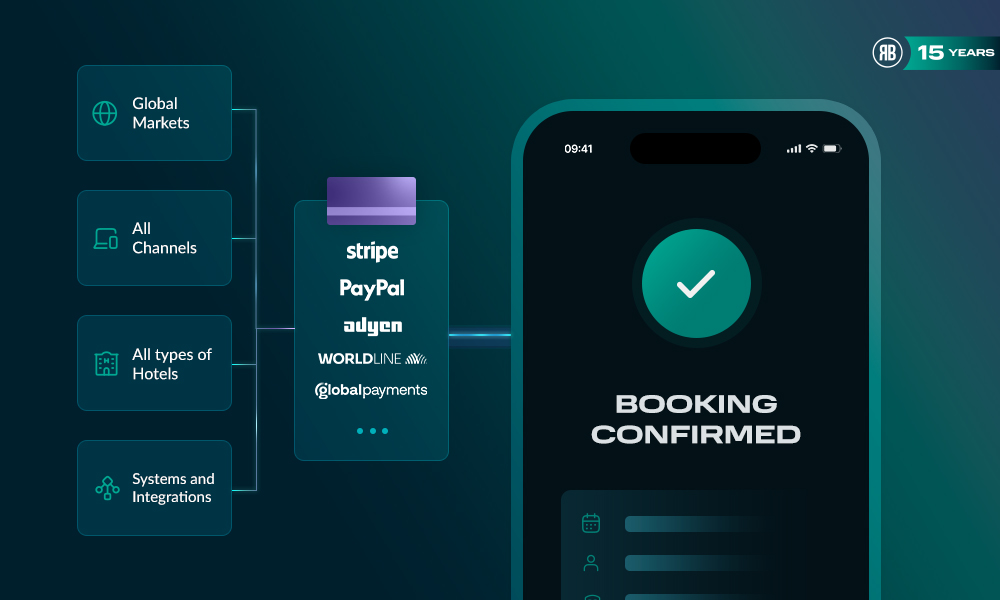
Flexibility in payment methods, payment gateways, and integrations is no longer just a technical issue. It is a key tool for improving the guest experience, increasing conversion rates, and maximizing the profitability of the direct channel.

Many hotels still view payment as the final step in the booking process. However, for the guest, it is part of the purchasing experience, and for the hotel, it represents one of the most critical moments in the booking process. Because, regardless of when or how the payment is processed, the payment experience remains one of the decisive moments in turning a purchase intention into a confirmed reservation.
Every extra click, every failed validation, or every missing payment method can become a barrier to conversion. An unfamiliar payment method, a declined card, or a lack of options tailored to the traveler’s market can lead to the guest abandoning the booking—even when they’ve already decided to book.
As travelers expect more streamlined and personalized shopping experiences, payments have become a key driver for increasing conversion rates, improving the guest experience, and boosting direct channel performance.
Payment influences conversion long before the final click
By the time a traveler reaches the booking engine, they have already gone through much of the decision-making process. They have compared options, checked prices, and selected the room that best suits their needs. However, many bookings are lost in the final steps.
Price isn't always the issue. In many cases, friction arises at the point of payment.
For example, a Brazilian guest might expect to find local payment methods. A U.S. traveler might feel more comfortable using PayPal. A European customer might value flexible payment options or installment plans. Similarly, a business might need specific solutions for managing corporate payments.
If the desired option is not available, the traveler can cancel the reservation even after selecting a room and rate.
Payment flexibility has a direct impact on conversion rates. A global study by Adyen on the hospitality industry (*) reveals that 37% of consumers have abandoned a booking process because they were unable to pay using their preferred method. In addition, 49% consider it important to have a wide variety of payment methods available.
The best conversion strategy doesn't end at checkout. It includes a payment experience tailored to each market and each traveler.
Payments are also part of the booking experience
Hotels invest in web design, digital marketing, and the optimization of their hotel booking engine to attract more traffic and increase direct bookings. However, if the payment process creates friction, much of that investment loses its effectiveness.
Guests do not view the reservation and payment as separate. They see them as a single experience. If the payment process raises questions or causes difficulties, the overall perception of the reservation suffers.
Travelers expect experiences similar to those they encounter in e-commerce. Speed and a frictionless experience have become basic expectations for the digital traveler. In the Adyen’s Hospitality & Travel Report 2025, speed, flexibility, and autonomy rank among the factors most valued by guests during the booking and payment process. In practice, travelers expect to find:
- Fast payment processing.
- Safe and reliable environments.
- Popular payment methods.
- Experiences optimized for mobile devices.
- Immediate confirmation.
A simple and intuitive payment process reduces uncertainty, builds trust, and makes it easier to complete the reservation.
And trust remains one of the main drivers of conversion in the hotel industry as well. 71% of travelers say they are concerned about potential fraud or scams when making reservations, while one in ten say they have experienced a payment-related incident in the hotel industry.
The payment strategy also affects profitability
Talking about payment solutions for hotels solely in terms of conversion is only part of the story. The right strategy can also have a direct impact on operational efficiency and the profitability of the direct channel.
Properly configuring payments can help:
- Reduce operating costs. Efficient payment management helps automate processes, reduce manual tasks, and minimize administrative issues, allowing teams to devote more time to higher-value activities.
- Reduce fraud and chargebacks. Today's payment solutions incorporate advanced security mechanisms that help protect transactions and reduce financial risk for the hotel.
- Optimize cash flow. The ability to set up different payment models—from advance payments to reservation deposits—provides greater control and predictability over revenue.
- Adapting sales policies. Flexibility in payment options allows us to design offers and terms tailored to different traveler profiles, balancing experience, conversion, and profitability.
The result is a more efficient and cost-effective direct channel.
There is no one-size-fits-all solution for all hotels
An international vacation resort does not have the same needs as a city hotel. Nor does a hotel chain with a global presence have the same needs as an independent property.
That's why flexibility is key.
The optimal payment strategy depends on factors such as source markets, customer mix, business model, cancellation policies, existing technology systems, and the banking and tax requirements of each transaction.
What works for one market or segment may not be the best option for another. That is why the ability to tailor payment strategies to the needs of each hotel has become a competitive advantage.
The Importance of an Open Payments Ecosystem
This is where technology comes into play. Beyond simply having a specific payment gateway, what matters is that the hotel can develop the payment strategy that best suits its business.
To make this possible, rather than offering a single solution, Roiback is committed to a flexible ecosystem of partners and integrations that allows each hotel to configure the combination of tools that best fits its markets, operations, and business objectives.
This flexibility is particularly important for hotels with an international presence or a diversified customer acquisition strategy, where payment preferences can vary significantly from market to market.
Roiback's booking engine is integrated with multiple international payment platforms, including:
- Stripe
- PayPal
- Adyen
- Worldline
- Global Payments
- Redsys
- Cybersource
- Nexi
- Fiserv
- Scalapay
- 2C2P
- Reduniq
Flexibility is no longer just about accepting payments. It's about offering guests the payment method they expect, at the time they expect it, and with the level of trust they need to complete their reservation.
In this way, the hotel can better align the needs of its source markets with its business and operational goals, without sacrificing conversion rates or profitability.
The future of the direct channel depends on eliminating friction
For years, the conversation about hotel distribution has centered on driving traffic, but attracting visitors is only part of the equation.
Actual profitability is achieved by converting that traffic into bookings.
And in that final stretch of the journey, payment plays a much more significant role than has traditionally been attributed to it.
Hotels that view payments as an essential part of the booking experience—rather than simply a financial transaction—will be better prepared to maximize conversion, adapt to international markets, and strengthen the profitability of their direct channel.
Conclusion
With direct bookings, every detail counts. Payments are no longer just the final step in the booking process on your booking engine—they’re a strategic tool for improving conversion rates, optimizing the guest experience, and increasing profitability.
Having the flexibility needed to adapt to the preferences of each market makes it possible to eliminate friction precisely where booking decisions are made.
Because the best payment isn't just one that processes correctly. It's one that eliminates friction, builds trust, and helps turn a purchase intent into a confirmed reservation. Because when a traveler decides to book, the last thing they should encounter is a barrier to payment.
Is your payment strategy helping you convert more direct bookings? Talk to our experts and find out how an optimized payment experience can help you eliminate friction, improve conversion rates, and maximize the profitability of your direct channel.
(*) Source: Hospitality & Travel Report 2025, Adyen. Available at: https://www.adyen.com/index-reports/hospitality
Read more

News
Is your hotel using more energy and water than it should? 5 signs to help you find out
By
Roiback
News
Roiback Receives Its Sixth Consecutive Award as the World's Best Hotel Booking Solutions Provider
By
Roiback
News
Roiback Participates in the Conference “The Balearic Islands: A Land of Opportunities for Strategic Projects” at the CEOE
By
Roiback


